By Rob Webster, RW Excavation & Demolition
Why accepting an insurance settlement too early—or hiring the wrong demolition contractor—could cost homeowners tens of thousands of dollars.
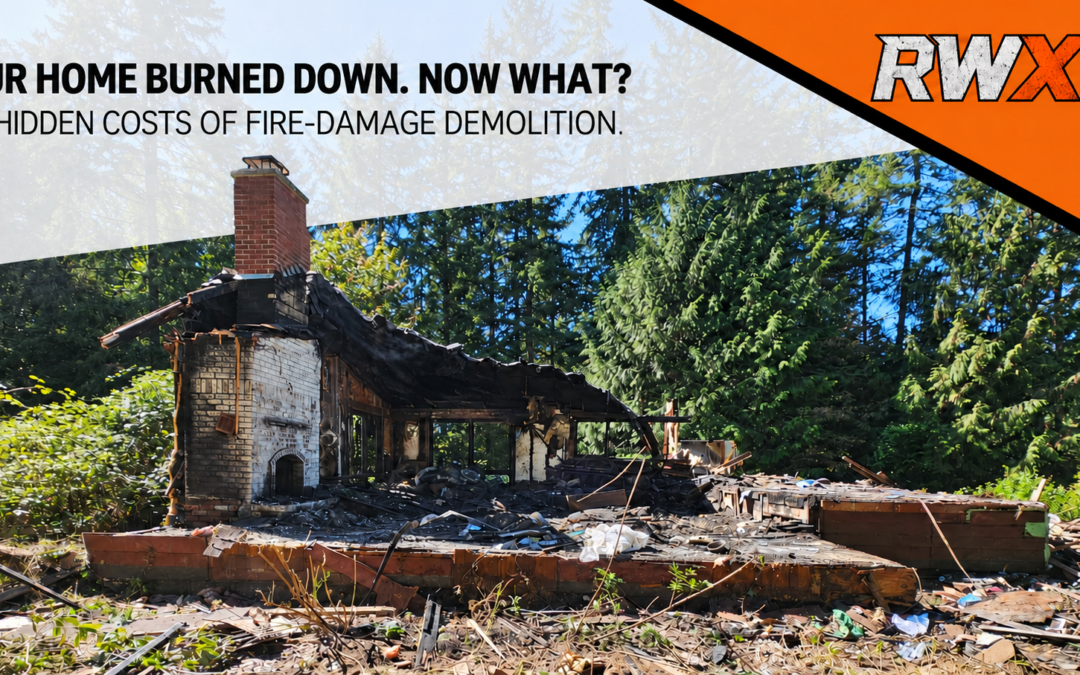
When a home is destroyed by fire, most property owners assume the next steps are relatively straightforward: contact the insurance company, settle the claim, hire a demolition contractor, and begin rebuilding.
Unfortunately, it's rarely that simple.
What many homeowners don't realize is that demolishing a severely fire-damaged structure can involve an entirely different set of regulatory requirements than conventional demolition.
Structural engineering, asbestos regulations, environmental air monitoring, certified personnel, specialized waste transportation, and disposal restrictions can dramatically increase the cost of the project.
In some cases, these requirements can double the cost of demolition.
And if the homeowner has already accepted an insurance settlement that doesn't account for these expenses, the financial consequences can be substantial.
Where Things First Go Wrong: The Insurance Settlement
After a total fire loss, homeowners typically contact their insurance company to report the claim.
The insurer evaluates the damage, discusses policy limits, and may establish an initial allowance for demolition, debris removal, paperwork, and permitting.
In some cases, the insurance company may also expect portions of the original structure, particularly the concrete foundation, to be salvaged and reused.
From the insurer's perspective, preserving the foundation can reduce the cost of rebuilding the home.
But this is often where expectations begin to fall apart.
An insurance company's initial demolition estimate may not account for the actual regulatory requirements of removing a severely burned structure.
Washington State's Department of Labor & Industries (L&I) and regional clean air agencies regulate various aspects of demolition, asbestos exposure, worker safety, and hazardous-material handling.
When a building has been severely damaged by fire, those requirements can become substantially more complicated.
The homeowner may have no idea that the demolition could require structural engineering evaluations, specialized asbestos procedures, industrial hygiene monitoring, and transportation of contaminated debris to an authorized disposal facility.
These are not minor expenses. They can add tens of thousands of dollars to a project.
What Happens If You've Already Accepted the Insurance Payment?
That depends on the insurance company, the policy, and the terms of the settlement.
An initial insurance payment does not necessarily prevent a homeowner from submitting supplemental costs. However, accepting a final settlement or signing a release before the complete demolition scope is understood can make recovering additional money more difficult.
At RWXD, we've successfully helped clients navigate these issues. We've also spoken with homeowners who reported significant financial losses after their insurance companies asserted coverage limits following payment.
The amount an insurance company initially offers and the amount required to complete a legally compliant demolition may be two very different numbers.
Before agreeing to a final demolition settlement, homeowners should understand what their property actually requires.
Step One: A Qualified Demolition Assessment
Before anyone begins removing a fire-damaged structure, the property should be evaluated by a demolition professional who understands structural hazards, asbestos regulations, and the requirements of the applicable clean air agency.
A building that has experienced extreme heat, partial collapse, or extensive structural damage may be unsafe to enter.
This creates a significant problem.
Under normal circumstances, an appropriately accredited asbestos inspector evaluates a building and collects samples of suspect materials before demolition.
But what happens when the building is too dangerous to enter?
What happens when floors have collapsed, walls are unstable, or the remaining structure presents a serious risk of injury?
You cannot simply send an inspector into a dangerous building to collect asbestos samples.
And you cannot assume that because the building burned down, asbestos regulations no longer apply.
This is where a specialized regulatory process may become necessary.
Understanding the Section 4.04(c) Variance — The “Red Can”
Within the jurisdiction of the Puget Sound Clean Air Agency, Regulation III, Section 4.04(c) provides a process for addressing certain structurally unsafe buildings that cannot undergo conventional asbestos removal before demolition.
In the industry, this process is sometimes referred to as a “Red Can.”
When the conditions are satisfied and the clean air agency grants approval, demolition may be permitted with asbestos-containing materials remaining in place because removing those materials beforehand would present unacceptable safety hazards.
A Red Can is not an automatic exemption, and a demolition contractor cannot grant one.
A structural engineer's evaluation may be necessary to document why the building is unsafe to enter.
The supporting documentation and proposed work plan are reviewed by the applicable clean air agency, which determines whether conditional approval can be granted.
The approval may allow demolition with asbestos-containing material left in place, subject to specific conditions.
Importantly, it does not waive the remaining asbestos-control requirements.
A Section 4.04(c) variance allows a specific demolition procedure under approved conditions. It is not permission to ignore asbestos regulations.
Other regional clean air agencies may have different procedures, and the requirements must be established for the property's jurisdiction.
Structural Engineering: An Expense Homeowners Rarely Expect
A demolition contractor can identify apparent structural hazards, but a formal engineering assessment may be needed to support an unsafe-structure determination.
This can require a licensed structural engineer to evaluate the remaining building and document why entering the structure would be unsafe.
Depending on the project, that evaluation can cost as much as $2,500.
Unfortunately, this may not be the only engineering evaluation required.
Why the Foundation May Need a Second Evaluation
Insurance companies sometimes want homeowners to preserve the original concrete foundation to reduce reconstruction costs.
However, concrete exposed to extreme heat can suffer significant damage.
Fire can cause cracking, spalling, loss of strength, and changes in the physical properties of concrete. Reinforcing steel and its bond with the surrounding concrete can also be compromised.
A foundation that appears intact after a fire may not be structurally suitable for reuse.
A qualified structural engineer should determine whether the foundation can safely support a replacement building.
The problem is that the foundation may be buried beneath debris or inaccessible while the damaged structure remains standing.
As a result, a homeowner may need:
- An initial structural evaluation to assess the damaged building and support the proposed demolition procedure.
- A second structural evaluation after demolition to determine whether the foundation can be salvaged.
At approximately $2,500 per evaluation, the engineering costs alone could reach $5,000.
These are illustrative costs based on project experience, not fixed agency fees.
A foundation should not be assumed reusable simply because an insurance company wants to preserve it.
That decision must be supported by an appropriate structural evaluation.
What Happens When Asbestos Cannot Be Safely Sampled?
When fire damage prevents a complete asbestos survey, inaccessible suspect materials may need to be presumed asbestos-containing and managed accordingly.
Potential lead hazards must also be addressed under applicable worker-safety and waste-management requirements, although asbestos and lead are subject to different regulatory standards.
For projects proceeding under a Red Can approval, the clean air agency may impose detailed conditions governing demolition, dust suppression, air monitoring, worker qualifications, and waste handling.
These conditions can turn what appears to be a straightforward demolition into a specialized environmental operation.
Certified Personnel and Protective Equipment
Regulated asbestos work requires appropriately qualified personnel and compliance with applicable training and certification requirements.
Depending on the operation, this may include a certified asbestos supervisor, workers holding the required asbestos certifications, respiratory protection, disposable protective clothing, and other exposure-control measures.
Tyvek-style protective suits and properly selected respirators are common components of this work.
Worker qualifications are not optional when certification requirements apply.
A conventional demolition crew is not automatically qualified to perform asbestos-related demolition work.
Continuous Water Saturation
A Red Can approval may require the structure to be saturated with water before demolition begins.
The structure and disturbed debris may need to remain continuously wet during demolition and through proper disposal.
This helps minimize the release of asbestos fibers and contaminated dust.
It also affects planning, equipment, water supply, runoff management, and overall project execution.
Independent Industrial Hygiene Monitoring
Another major expense is environmental air monitoring.
A clean air agency may require air sampling at multiple locations surrounding the demolition activity, including upwind and downwind monitoring points.
For example, a project-specific monitoring plan may require three downwind locations and one upwind location, with daily sampling and comparison of results.
An independent certified industrial hygienist may be required to remain on site during demolition, oversee monitoring, evaluate discrepancies, and stop work when conditions warrant.
These safeguards protect workers, neighboring properties, and the surrounding environment.
But they also carry a significant cost.
Based on RWXD's project experience, industrial hygiene monitoring can cost approximately $2,250 per day.
For a five-day demolition, that could mean $11,250 in environmental monitoring expenses alone.
Monitoring requirements depend on the specific approval and jurisdiction; the same sampling arrangement does not automatically apply to every fire-damage demolition.
The Disposal Problem: Why Burned Debris May Have to Travel to Oregon
Even after the structure has been safely demolished, the project is far from complete.
Debris classified as asbestos-containing or asbestos-contaminated waste must be handled, packaged, transported, and disposed of according to applicable requirements.
It cannot simply be loaded into an ordinary dumpster and hauled to whichever landfill offers the lowest disposal rate.
On projects RWXD has encountered, waste management providers such as Waste Management or DM Recycling have been involved in coordinating containers, waste classification, transportation, and disposal arrangements.
In some cases, this involves 40-yard containers prepared with double layers of heavy-duty plastic, including 10-mil liner specifications, with the contents fully enclosed and secured to prevent material from escaping during transportation.
The precise packaging and liner requirements depend on the applicable regulations, waste classification, and receiving facility.
The Real Cost of Regulated Waste Disposal
Based on RWXD's project experience, each specialized 40-yard disposal container can cost approximately $3,600, and a single container may accommodate debris from only 500–1,000 square feet of fire-damaged structure.
That means a typical residential demolition may require several containers, depending on the building's size, construction materials, extent of fire damage, and volume of remaining debris.
For example:
| Structure size | Estimated containers | Disposal cost |
|---|---|---|
| 1,000 SF | 1–2 | $3,600–$7,200 |
| 1,500 SF | 2–3 | $7,200–$10,800 |
| 2,000 SF | 2–4 | $7,200–$14,400 |
| 2,500 SF | 3–5 | $10,800–$18,000 |
| 3,000 SF | 3–6 | $10,800–$21,600 |
Estimates are illustrative, based on approximately 500–1,000 square feet of structure per container and $3,600 per container. Actual quantities and charges depend on debris volume, loading limitations, and disposal arrangements.
A 2,500-square-foot home could incur $10,800–$18,000 in specialized container disposal charges alone.
And that's before demolition labor, equipment, environmental monitoring, engineering, and other compliance costs.
Why Disposal Can Become So Expensive
For some Western Washington fire-damage projects, the authorized disposal route has involved transporting asbestos-related debris to a facility in Oregon, more than three and a half hours south of Tacoma.
Instead of a short trip to a local landfill, the project may require long-distance hauling to a facility authorized to accept the waste.
This introduces additional transportation costs, specialized container expenses, disposal fees, and scheduling complications.
And scheduling is often a problem.
Coordinating regulated waste containers can be difficult even when the demolition contractor is actively working with the waste management provider.
Delayed container deliveries or exchanges can interrupt demolition operations, extend the project schedule, and increase labor, equipment, and monitoring costs.
A contractor can have the demolition operation ready to proceed and still lose productive time waiting for regulated waste containers.
This is one of the many expenses and logistical complications that may not be reflected in an initial insurance estimate.
A Red Can Doesn't Eliminate the Property Owner's Responsibility
One of the most important things homeowners need to understand about a Section 4.04(c) approval is what it does not authorize.
A Red Can is intended to address the specific hazards associated with demolishing a structurally unsafe building when conventional asbestos removal cannot safely be performed.
It does not automatically eliminate other asbestos-control obligations.
The property owner remains responsible for compliance with applicable regulations, even when a demolition contractor is hired to perform the work.
Another important consideration is what happens as demolition progresses.
Once the conditions that justified the unsafe-structure approval no longer exist, the special authorization may cease to apply to the remaining work. The applicable asbestos-control requirements must then be followed.
In other words, a contractor cannot assume that the entire project is exempt from ordinary asbestos procedures simply because a Red Can was issued.
The demolition must follow the approved work plan, agency conditions, and applicable regulations throughout the project.
Failure to comply can result in enforcement action, project delays, and additional costs.
The Financial Reality: Specialized Demolition Can Cost Twice as Much
Consider a fire-damaged home requiring two structural engineering evaluations, five days of industrial hygiene monitoring, and four specialized disposal containers.
| Additional project requirement | Illustrative cost |
|---|---|
| Initial structural engineering evaluation | $2,500 |
| Foundation structural evaluation | $2,500 |
| Industrial hygiene monitoring — 5 days | $11,250 |
| Specialized disposal — 4 containers | $14,400 |
| Total | $30,650 |
That's $30,650 before accounting for demolition labor, equipment, certified asbestos personnel, protective equipment, and other project-specific costs.
Depending on the disposal agreement, additional transportation charges may also apply.
For some structures, the total cost of demolition and debris removal can be twice what a conventional demolition would cost.
Now imagine the homeowner accepted an insurance settlement based on the lower conventional demolition estimate.
The difference may be substantial.
And depending on the policy limits and settlement terms, the homeowner could be responsible for some or all of the shortfall.
This is why the demolition scope should be understood before a final insurance settlement is accepted.
Hiring the Wrong Contractor Can Create Serious Legal and Financial Problems
One of the biggest mistakes a homeowner can make is assuming that any licensed demolition contractor is qualified to handle a severely burned structure.
There is a significant difference between conventional demolition and demolition involving presumed asbestos-containing materials under a conditional clean air agency approval.
A contractor who ignores asbestos requirements, fails to use properly qualified personnel, mishandles contaminated debris, or disposes of regulated waste improperly can create serious consequences.
These can include regulatory fines, cleanup orders, work stoppages, additional disposal costs, and potential civil liability arising from contamination or exposure.
Workers, neighbors, surrounding properties, and the environment can all be affected by improper demolition practices.
And the homeowner may not be insulated from responsibility simply because they hired someone else to perform the work.
The extent of any legal liability depends on the circumstances, but the financial exposure can be significant.
The cheapest demolition bid can become the most expensive decision a homeowner makes after a fire.
Before hiring a contractor, verify that they understand the applicable regulations, can identify the necessary certifications and qualified personnel, have a credible hazardous-material management plan, and can explain exactly how and where the debris will be disposed of.
A contractor who provides a low price without addressing these issues should raise immediate concerns.
Protect Yourself Before Accepting a Final Insurance Settlement
Insurance companies and homeowners may approach the same loss from very different perspectives.
The insurance company is evaluating the claim under the terms and limits of the policy. The homeowner needs to understand what it will actually take to remove the damaged structure and prepare the property for rebuilding.
Those two considerations do not always produce the same initial estimate.
Before finalizing a demolition settlement, homeowners should obtain a qualified assessment that addresses the building's structural condition, asbestos survey limitations, potential Red Can requirements, foundation integrity, environmental monitoring, personnel qualifications, and waste disposal.
This information can help establish a realistic scope of work and provide documentation for discussions with the insurance adjuster.
It is also important to understand whether a payment is preliminary, undisputed, supplemental, or part of a final settlement and release.
Accepting an initial payment does not automatically eliminate the right to seek additional covered expenses. However, final settlement terms and policy limits can materially affect what remains recoverable.
When the demolition scope is uncertain, homeowners should consider obtaining appropriate insurance or legal advice before signing a final release.
Do not assume the insurance company's initial demolition allowance is enough simply because it was presented as part of the claim.
Find out what the project requires first.
Final Thoughts: Know the Requirements Before the Money Is Gone
A devastating house fire is already a major personal and financial loss.
Homeowners shouldn't have to discover halfway through demolition that their insurance allowance doesn't cover the work, their foundation cannot be reused, or their contractor isn't qualified to handle the materials on site.
Fire-damage demolition can involve structural engineering, conditional clean air agency approvals, certified asbestos personnel, environmental monitoring, specialized waste handling, and transportation to authorized disposal facilities.
These requirements protect workers, neighboring properties, and the environment. They also have real costs that need to be understood from the beginning.
The most important decision you make after a fire may be the one you make before accepting the insurance company's final demolition settlement.
At RWXD, we've helped property owners navigate the complexities of fire-damage demolition and the associated insurance challenges.
Our advice is straightforward:
Have the structure evaluated by a knowledgeable demolition professional first. Understand the regulatory requirements. Establish the actual scope and cost of the work. Then address those costs with your insurance company before finalizing the settlement.
Because losing your home to a fire is devastating enough. You shouldn't have to suffer another major financial loss because the true cost of demolition was never explained.
Before You Accept an Insurance Settlement, Call RWXD.
Your home has already been destroyed by fire. Don't let an inadequate insurance settlement or an unqualified demolition contractor turn one devastating loss into two.
At RWXD, we understand that fire-damage demolition is far more complicated than simply tearing down a structure and hauling away the debris.
From structural engineering and Red Can (Section 4.04(c)) approvals to asbestos compliance, environmental monitoring, specialized waste disposal, and foundation evaluations, we know what needs to be considered before the first piece of debris is removed.
More importantly, we understand how these requirements can affect your insurance claim.
We've helped homeowners navigate complicated demolition requirements and address unexpected costs with their insurance companies. We know the questions that need to be asked, the regulatory issues that need to be identified, and the expenses that can be overlooked in an initial demolition estimate.
Don't Negotiate Your Demolition Settlement Without Knowing the Real Cost.
Before accepting a final insurance settlement or signing a demolition contract, contact RWXD.
We can help you:
- Understand the true scope of demolition before committing to an insurance settlement that may not cover the work.
- Identify potential Red Can requirements, structural engineering needs, and hazardous-material compliance issues.
- Evaluate foundation salvage expectations before assuming fire-damaged concrete can safely be reused.
- Understand the costs of regulated disposal, including specialized containers, environmental monitoring, and transportation.
- Develop a realistic demolition scope and estimate that can support informed discussions with your insurance adjuster.
- Avoid costly contractor mistakes that could expose you to regulatory penalties, environmental liability, and additional cleanup expenses.
The Insurance Company Has Its Adjuster. You Need Someone Who Understands Demolition.
Your insurance company evaluates what your policy covers. RWXD evaluates what your damaged property actually requires.
Those are two different responsibilities, and understanding the difference could save you thousands of dollars.
Don't wait until you've accepted a settlement, hired the wrong contractor, or discovered that your demolition costs are twice what you expected.
Contact RWXD today for a fire-damage demolition assessment. Get the facts, understand your options, and protect yourself before making decisions that could cost you thousands.
RWXD | Fire-Damage Demolition, Excavation & Site Preparation — Western Washington
Recent Comments